Noise Monitoring

Certification
The Importance of Noise Monitoring at the Workplace
Expert Noise Assessments
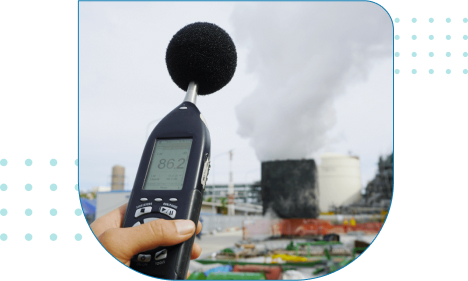
Our Certified Industrial Hygienists use professional equipment to perform detailed noise assessments, ensuring accurate and reliable results. We provide comprehensive reports that detail noise levels, identify sources of excessive noise, and offer actionable recommendations for noise control.
Criterion Labs’ noise monitoring process includes:
- Workplace Noise Surveys: Conducting comprehensive noise surveys to measure and map out noise levels throughout the workplace. We also provide sound level “spot-checks” of equipment or processes to assure whether or not employee monitoring is necessary, or to assess if engineering controls to lower noise levels are needed.
- Personal Noise Exposure Monitoring: Measuring individual workers’ exposure to noise over their work shifts to ensure compliance with occupational safety standards. Quest dosimeters are placed on employees or at “fence lines” to monitor and record noise levels.
- Noise Source Identification: Identifying the primary sources of noise within the workplace and evaluating their impact on overall noise levels.
- Evaluation of Noise Control Measures: Assessing the effectiveness of existing noise control measures and recommending improvements as needed.
Regulatory Compliance
Noise Control Strategies
Based on our noise assessments, we develop customized noise control strategies tailored to your specific workplace conditions. These strategies may include:
- Engineering Controls: Implementing modifications to equipment, processes, or the workplace layout to reduce noise levels at the source.
- Administrative Controls: Establishing work practices and policies that minimize workers’ exposure to noise, such as rotating shifts or redesigning workflows.
- Personal Protective Equipment (PPE): Recommending and providing appropriate hearing protection devices for workers, along with training on their proper use and maintenance.
FAQ
What is an OSHA Noise Survey, and when is it legally mandated for an employer
An OSHA Noise Survey is a comprehensive evaluation of sound levels within a facility to determine if employee exposures exceed regulatory limits. Under OSHA 29 CFR 1910.95, employers are legally mandated to implement a continuous Hearing Conservation Program if worker exposure meets or exceeds an 8-hour Time-Weighted Average (TWA) of 85 decibels (dBA), known as the Action Level.
Criterion Labs conducts formal noise surveys to protect your workforce from occupational hearing loss and insulate your business from costly OSHA citations.
What is the difference between personal noise dosimetry and sound level “spot-checks”?
Criterion Labs utilizes a multi-tiered diagnostic approach to accurately measure workplace sound environments depending on your facility’s operational layout:
- Sound Level “Spot-Checks”: Our noise experts use specialized sound level meters to map static noise zones around specific machinery or manufacturing lines. This helps determine if comprehensive worker testing is necessary or evaluates the real-world reduction of engineering controls.
- Personal Noise Dosimetry: We equip employees with advanced, calibrated dosimeters worn throughout their standard work shifts. This captures true personal exposure data, including variable mobile tasks, to calculate an exact 8-hour time-weighted average (TWA).
What is Community or Environmental Noise Monitoring, and how are "fence-line” metrics used?
Unlike occupational monitoring, Community Noise Monitoring focuses on environmental sound propagating across property boundaries into surrounding residential or commercial areas. Most municipalities enforce strict local noise ordinances governing decibel levels.
Criterion’s noise experts deploy perimeter “fence-line” measurements to investigate municipal noise complaints, evaluate construction site impact, or provide baseline data for commercial zoning approvals. Our comprehensive reporting includes precise physical data, source tracking, and actionable mitigation engineering strategies.
Why is it critical that noise monitoring data be traceable to NIST standards?
In noise litigation, zoning hearings, or formal OSHA disputes, your data is only as good as the calibration backing it. Criterion Labs ensures that all sound level meters and personal dosimeters utilized by our industrial hygiene staff yield data completely traceable to the National Institute of Standards and Technology (NIST). This rigorous baseline calibration guarantees that our physical field findings stand up under strict legal cross-examination, corporate liability defense, and regulatory agency scrutiny.
What solutions does Criterion Labs provide if noise levels exceed legal limits?
If our diagnostic evaluation identifies decibel levels exceeding safety thresholds, Criterion’s cross-disciplinary industrial hygienists and engineers assist your team with a structured control strategy:
- Engineering Control Feasibility: Evaluating structural acoustic barriers, dampening enclosures, or machine vibration mounts to minimize noise at the mechanical source.
- Administrative Safeguards: Designing modified employee shift rotations to legally limit individual duration exposure times within high-decibel zones.
- PPE & Hearing Protection Auditing: Selecting properly rated Hearing Protection Devices (HPDs) based on their specific Noise Reduction Rating (NRR) to match your facility’s distinct decibel profile.