Drinking Water Test Kits
Why Test Your Drinking Water?
Contaminants in drinking water can come from various sources, including natural deposits, industrial discharges, disinfection byproducts, and agricultural activities.
Because many harmful contaminants are completely odorless, tasteless, and invisible, regular analytical testing is the only way to identify and mitigate potential health risks. Our test kits detect harmful substances and ensure compliance with health standards.
The Criterion Drinking Water Test Kits
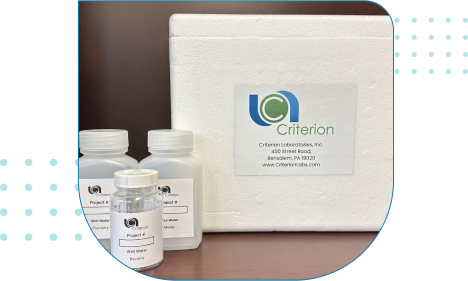
Criterion offers 16 different drinking water test kits, which can be shipped to your location, or you can pick-up and drop-off samples for a reduced cost.
Experienced Criterion staff can collect your samples within the greater Philadelphia region and transport them directly to our laboratory for an additional fee. Contact us for pricing and availability.
| Drinking Water Test Kit: | Description: | Recommended For: |
| PFAS (Per- and PolyFluoroAlkyl Substances) | PFAS (“Forever Chemicals”) analysis. Identifies 25 different PFAS compounds in water using EPA Method 533 | Well owners and anyone concerned about PFAS contamination |
| Standard Drinking Water | Tests for common contaminants such as: Lead (Pb), Copper, Coliform/E. Coli, Anions, Turbidity, pH, Hardness | An initial water scan to check for common problem contaminants |
| Advanced Drinking Water | This kit provides results for over 55 analytes | A comprehensive overview of your water quality |
| Well Water | Tests for common well water contaminants | Testing well water |
| Municipal Water | Tests for contaminants in Municipal Water, incl. Lead (Pb), Copper, Free and Total Chlorine, Total Dissolved Solids, and more | Anyone using municipal (public) water systems |
| Microbiology | Comprehensive Microbiological Profile. Tests for Endotoxins, Legionella, Coliform/E. Coli, HPC | A comprehensive scan of potential organisms in your water |
| Metals & Minerals | Comprehensive profile by testing for 12 metals and minerals using EPA Method 200.5 for trace metals. | Identifying potential problem metals and minerals |
| Coliform & E. coli | Determines the presence or absence of coliform and E. coli in water via Colilert using Standard Method 9223B. | Discovering the most common form of bacterial contamination – Coliform & E. coli |
| Heterotrophic Plate Count (HPC) | Determines the concentration of heterotrophic bacteria in water using Standard Method 9215B. | Estimates the number of live carbon-consuming bacteria, mold, and yeast in your water |
| Legionella | Detects the presence of Legionella bacteria in water using ISO 11731 to identify and quantify Legionella species. | Checking for the dangerous Legionella organism in your water |
| Metals | Identifies a range of metals in water using EPA Method 200.5 for trace metals | Scanning your water for potential metal contaminants |
| Volatile Organic Compounds (VOC) | Quantifies all regulated VOCs in water using EPA Method 524.4 | Discovering potential Volatile Organic Compounds in your water |
| Pesticides | Detects certain pesticides in water using EPA Method 505 | Identifying potential pesticides in your water |
| Disinfection Byproducts (DBP) | Determines the presence or absence of Chlorine Residual Compounds such as Haloacetic Acids (HAAs) & Dalapon and Total Trihalomethanes (THMs) | Checking for chlorine residual compounds resulting from well chlorination or municipal water |
| Water Chemistry | Measures Alkalinity, pH, Hardness, Total Dissolved Solids, Free and Total Chlorine, Turbidity, and Conductivity | Analyzing the performance of your water softener, neutralizer and/or Reverse Osmosis System |
| Minerals & Anions | Detects various inorganic ions in water using EPA Method 300.0, such as Nitrates, Nitrites, Chloride, Fluoride, Bromide and Sulfate | Testing for the presence of negatively charged water contaminants |
FAQ
How do I know what drinking water contaminants I should test for?
Why should I test my drinking water with an accredited laboratory instead of home test strips?
Over-the-counter DIY test strips only provide rough, colorimetric estimates and frequently miss low- level toxic contaminants. Criterion Labs utilizes state-of-the-art analytical equipment (ICP-AES, GC-MS) to provide precise, certified laboratory quantification down to parts-per-billion (ppb) or parts-per-trillion (ppt) levels. An accredited lab report provides legally defensible data necessary for real estate transactions, medical evaluations, or installing proper filtration equipment.
What are the most common drinking water quality issues in our area (greater Philadelphia)?
Most of the residents in this area are on municipal water. The contaminants mainly come, not from the treatment Plant, but from the delivery system or even your home plumbing and fixtures. The most common complaints from municipal water are taste, smell, and staining. These are mainly due to chlorine, TDS, iron, lead, copper, and possibly bacteria. Our Municipal Water Kit covers all these issues and more. For clients on wells in the surrounding area, the main issues are usually bacteria, pH, hardness, metals, sulfur (Hydrogen Sulfide), and Nitrate/Nitrite. Our Well Water Kit covers all these tests and more.
Note: Research from Penn State indicates that more than half of all private wells in Pennsylvania have detectable levels of PFAS in them, with 18% of all wells exceeding the U.S. EPA’s Maximum Contaminant Levels (MCL) for safe drinking water!
What drinking water test kits does Criterion Labs offer?
Criterion offers 16 specialized test kits that can be shipped directly to your door or picked up at our Laboratory:
- Targeted Panels: PFAS “Forever Chemicals”, Coliform & E. coli, Lead & Heavy Metals, Volatile Organic Compounds (VOCs), Nitrates/Nitrites, and Legionella.
- Comprehensive Packages: Standard Drinking Water, Advanced Drinking Water, Well Water Safety Panels, Municipal Water Verification, and Disinfection Byproducts (DBP).